
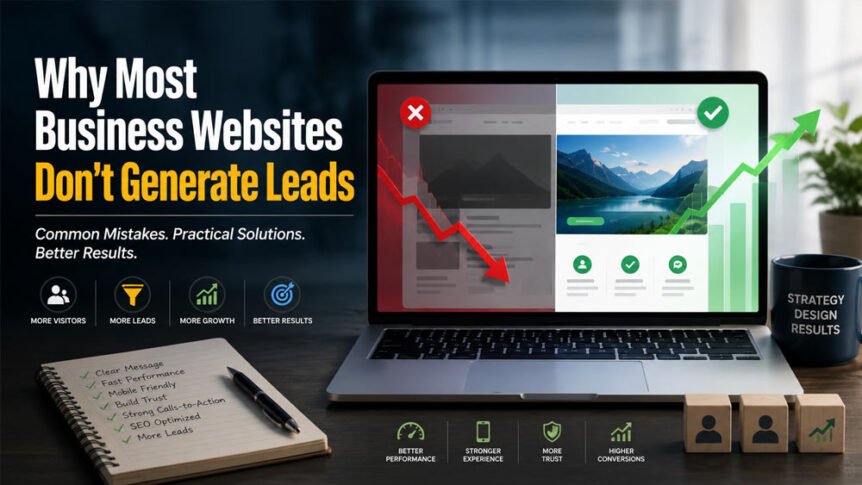
Your website should be your hardest-working salesperson—available 24/7, answering questions, building trust, and encouraging visitors to take action. Yet for many businesses, it does none of those things.
Businesses often invest thousands in a professionally designed website only to discover that traffic doesn’t convert into enquiries, consultations, or sales. The issue usually isn’t the product or service. It’s how the website communicates value, guides users, and removes friction during the buying journey.
At CreativeAmit, we’ve reviewed and designed websites for businesses across industries, and we’ve found that the same issues appear repeatedly. The good news is that they’re fixable.
In this guide, we’ll explain the most common reasons business websites fail to generate leads and the practical improvements that can turn your website into a conversion-focused marketing asset.
1. Your Website Talks About You Instead of Your Customer
One of the biggest mistakes businesses make is filling the homepage with company history, mission statements, and generic marketing language.
Visitors don’t arrive asking:
“Who are you?”
They arrive asking:
“Can you solve my problem?”
Instead of opening with information about your business, clearly communicate:
- What you do
- Who you help
- Why you’re different
- What action visitors should take next
A strong headline followed by a concise explanation creates immediate clarity.
2. Slow Websites Lose Potential Customers
Website speed affects both user experience and search engine rankings.
Research consistently shows that visitors abandon websites that take too long to load.
Common causes include:
- Oversized images
- Poor hosting
- Excessive plugins
- Unoptimized JavaScript and CSS
- No caching
Improving performance not only creates a better experience but often increases enquiries because users remain engaged longer.
Best practices
- Compress images
- Use modern image formats
- Enable caching
- Choose quality hosting
- Minimize unnecessary scripts
3. Your Website Doesn’t Build Trust
People rarely contact a business after seeing only a logo and a list of services.
They want reassurance.
Trust signals include:
- Client testimonials
- Google reviews
- Portfolio examples
- Before-and-after projects
- Case studies
- Industry certifications
- Years of experience
- Client logos
The faster visitors trust your business, the faster they’ll become customers.
4. Weak Calls-to-Action
Many websites leave visitors wondering:
“What should I do next?”
Every important page should encourage a single primary action.
Examples include:
- Request a Quote
- Schedule a Consultation
- Book a Discovery Call
- Download a Brochure
- Contact Our Team
Avoid presenting too many competing options.
5. Poor Mobile Experience
More than half of website visitors now browse on mobile devices.
Unfortunately, many business websites are still designed primarily for desktop.
Common problems include:
- Small buttons
- Difficult navigation
- Tiny text
- Slow loading
- Poor spacing
A mobile-first approach ensures visitors enjoy a smooth experience regardless of device.
6. Generic Templates Don’t Differentiate Your Brand
Templates save development time, but they shouldn’t define your business identity.
If your website looks identical to dozens of competitors, visitors have little reason to remember your brand.
Custom design allows businesses to communicate:
- Brand personality
- Unique value proposition
- Professional credibility
- Competitive advantages
Your website should feel like your business—not like a theme demonstration.
7. SEO Was Added Later Instead of Built In
Many websites are launched first and “optimized for SEO” afterward.
Effective SEO begins during planning.
Important considerations include:
- Keyword research
- Information architecture
- Internal linking
- Heading hierarchy
- Meta titles
- Schema markup
- Fast loading
- Mobile usability
SEO and great design should work together from day one.
8. Navigation Creates Friction
Visitors shouldn’t have to think about where information is located.
Simple navigation improves user experience.
Recommended structure:
- Home
- About
- Services
- Portfolio
- Industries
- Blog
- Contact
Limit unnecessary menu items and keep labels intuitive.
9. Your Website Doesn’t Answer Customer Questions
Every unanswered question increases the chance that visitors leave your website.
Helpful content includes:
- Pricing guidance
- Timelines
- Process explanation
- Frequently Asked Questions
- Service comparisons
- Project examples
Businesses that educate visitors often convert better because they reduce uncertainty.
10. You’re Measuring Design Instead of Results
A visually attractive website isn’t necessarily an effective one.
Instead of asking:
“Does it look modern?”
Ask:
- Are visitors contacting us?
- Are enquiries increasing?
- Are people staying longer?
- Are landing pages converting?
Good web design combines aesthetics with measurable business outcomes.
How to Build a Website That Generates More Leads
Businesses that consistently generate enquiries usually focus on the same fundamentals:
- Clear messaging
- Fast loading speed
- Mobile-first design
- Strong trust signals
- Effective calls-to-action
- SEO-friendly structure
- High-quality content
- Simple navigation
- Regular testing and improvement
Rather than treating a website as a one-time project, they view it as an ongoing marketing investment.
Final Thoughts
A business website should do much more than showcase products or services. It should educate visitors, establish credibility, answer questions, and make it effortless for potential customers to take the next step.
Whether you’re launching a new website or redesigning an existing one, focusing on user experience, performance, SEO, and conversion optimization will deliver far greater long-term value than simply following the latest design trends.
If your current website isn’t generating the enquiries you expect, it may not need a complete rebuild. Often, a series of strategic improvements can dramatically improve performance.
At CreativeAmit, we design custom WordPress websites that combine modern design, SEO best practices, and conversion-focused user experiences to help businesses generate more qualified leads and long-term growth.
Frequently Asked Questions
Why do many business websites fail to generate leads?
Most business websites fail because they focus on appearance instead of user experience, clear messaging, trust-building, and conversion optimization. Slow loading speeds, poor navigation, weak calls-to-action, and lack of SEO also contribute to low performance.
How can I improve my website’s conversion rate?
Improve page speed, simplify navigation, strengthen calls-to-action, showcase testimonials and case studies, optimize for mobile devices, and create content that answers your customers’ most common questions.
Is custom website design better than using a template?
Templates can be suitable for simple projects, but custom website design provides greater flexibility, stronger branding, improved user experience, and better opportunities for SEO and lead generation.
Does website speed affect SEO?
Yes. Fast-loading websites generally provide a better user experience and are more likely to perform well in search results. Website speed also influences visitor engagement and conversion rates.
Why choose CreativeAmit for business website design?
CreativeAmit specializes in creating custom, conversion-focused WordPress websites that combine professional design, SEO best practices, responsive development, and user-centered experiences tailored to business goals.